 Droplift
The drop lands when you’re ready
A workout planner and an adaptive music player, all in one app, for people who train hard. Chill music loops through your rest for as long as you need, and then you tap ready, and lift to a timed drop.
Recorded in the app
One button, three states
-
Ready
Chill music loops while you rest, allowing you to prepare mentally for your next lift. A rest timer starts, and you can stay in this state until you’re ready.
-
Building
You tap ready. A build-up starts straight away on the next bar. Your adrenaline rises, your heartbeat increases, and you get into your ready position to lift.
-
Lift
The drop lands on your first rep and continues until you finish your set, before phasing out into the next chill section and returning you to the rest state.
Your music defines your workout
It is not just motivation. The build up to your lift changes how much force you then produce. In one study, 52 male athletes were at their strongest on a grip test right after fast, loud music — which is exactly what our build and drop are for.
The mechanism is arousal. Tested on elite athletes, maximal strength rose with positive arousal. Which is why the timing matters so much. You do not want to be at your strongest while resting; it needs to land as you lift.
Which led us to a question. Why are music and workout apps separate? Moving between them mid-session is clunky, and timing a drop to your lift by hand is worse — it is easy to miss, and you end up resting through a drop with your headphones blasting, then starting your heaviest set on an outro.
The hardest part of the track has to land on the hardest part of your set. That is the one thing a playlist cannot do, because it has no idea when your set starts — and it is exactly what defines our purpose. We adapt your music to your workout plan, and give you the power to choose when to lift.
Karageorghis et al., Scandinavian Journal of Medicine & Science in Sports (2018) — 52 male athletes, grip strength measured after pretask music, across five tempo × volume conditions. Perkins, Wilson & Kerr, Journal of Applied Sport Psychology 13 (2001) — 28 athletes; maximal strength under high positive arousal, induced by imagery and paced breathing.
It’s like having a personal DJ by your side while you work out.
James Longman · Personal trainer
The Mix Engine
| Mixed on the beat | Every track is beatmatched and every transition lands on the bar line, so one track becomes the next without you noticing the join. It sounds like a set, not a playlist on shuffle. |
|---|---|
| Intensity maps to energy | You rate each set 1–5. Droplift matches that to how hard a track’s drop hits, and force-matches the session’s top set to the heaviest drop it has. |
| Built for chalky hands | We’ve designed our UI using a minimalistic approach. The ready button is large, and making changes mid-workout is seamless. |
| Artists paid per play | Every track is licensed directly from the producer, and credited on screen with a link out to their preferred socials. They earn a share of the revenue we generate. |
It is a training app first
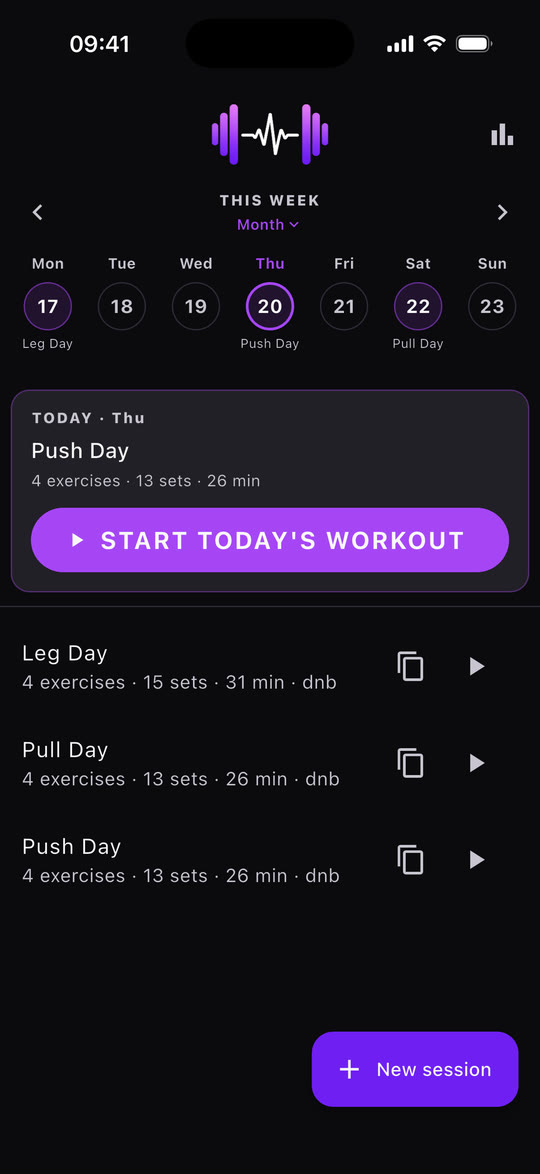
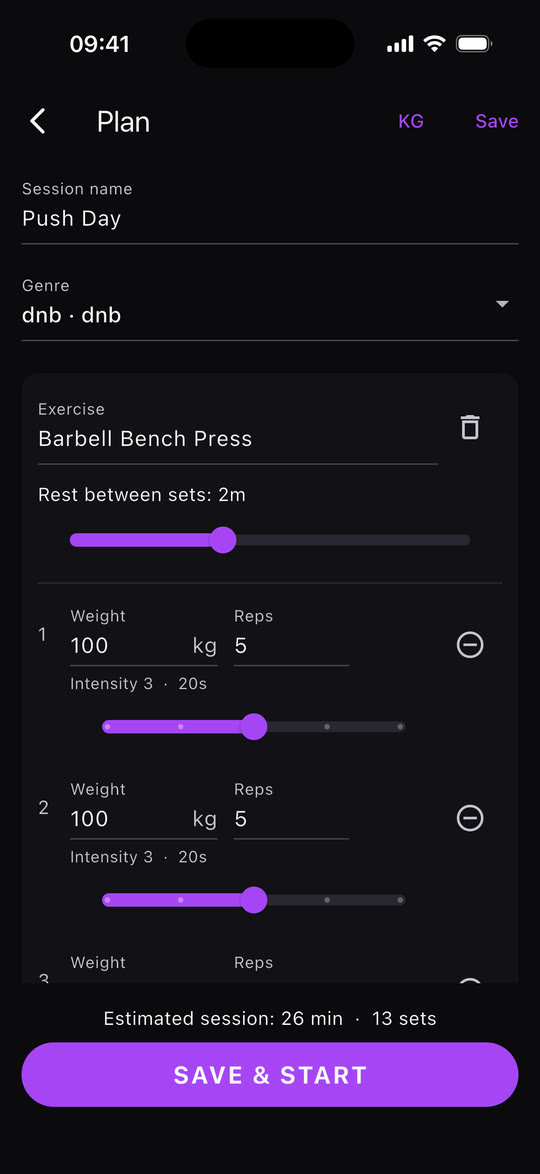
The plan is not an afterthought that picks a playlist — it is what the mixer builds the session around. Exercises, sets, reps, rest and how hard each set is going to be, all of it feeding the music. Build a routine once, put it on a day of the week, and your phone opens on it.
Everything stays editable mid-session. Add a set, drop one, reorder what is left because the rack is busy — the mix re-plans around the change rather than starting over.
We pay a share of the revenue directly to artists
The catalogue is signed track by track from independent phonk, drum & bass, hardstyle and harder EDM producers, on a non-exclusive deal that pays a share of subscription revenue back every quarter. Their name is on screen every time their track plays, linked to wherever you can hear more of it.
We sign artists purposefully, preferring to support small individual artists where we can. We are always open to new tracks, and would love for you to be a part of our vision.
Questions we get
Can I use my own music?
Unfortunately not. Our mixing engine requires knowing where the different sections of a track reside, and we mark those by hand to ensure smooth transitions. To get new music in, contact us — if demand is high enough we can try to reach the artist.
What does it sound like?
Tracks are mixed in a professional way, using a combination of our own domain expertise and direct communication with the artists, to make sure they are happy with how their tracks sound live in a workout.
Does it work offline?
We operate online in order to fetch tracks and mix live. Droplift lets you change your exercises and sets on the fly mid-workout, so a connection is required to load new tracks and insert them into the mix effectively.
Does it track my lifts?
Yes. Routines, sets, reps and weight are recorded every session, with progression charts and personal bests.
Is it on Android?
Yes — Android and iOS ship at the same time.
What will it cost?
We let each user try our app with a full-featured free trial. After the trial we charge £4.99 a month, to support our running costs and to pay back the artists who are integral to making your lifts feel more powerful.
Our first 1,000 founding members get an exclusive locked price for life at £3.99 a month.
I make music. How do I get in?
Send it over — the artists page has the terms and the form.
Train to the drop
Droplift is in testing on iOS and Android. Leave an address and you’ll hear from us when there’s a build worth handing over.